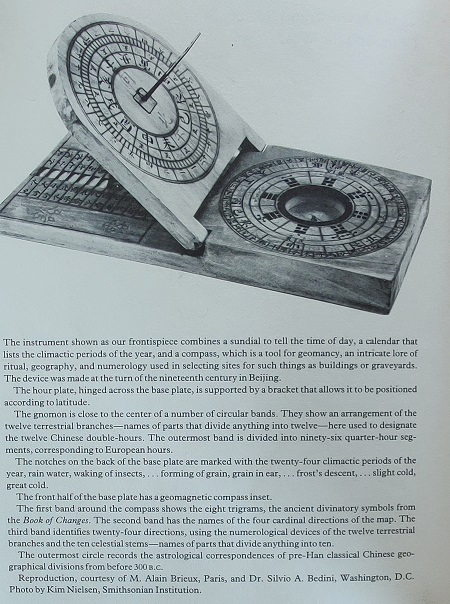
Sundial, Type B

Sundial, Type B
MYSTERY SOLVED

Thursday, May 14, 2026

The Calendar and the Magic Square

The Chinese Magic Square has always been known to have correspondences with Time and Space. This post will demonstrate how the 13x13 magic square and the 27x27 magic square communicate the numbers associated with the keeping of time and therefore were integral to the foundation of Chinese metaphysics. We start with the 13x13 magic square, the numbers of the calendar, and conclude with the grand daddy of all magic squares, the 27x27 magic square in the Luo Shu format.

THE 13X13 MAGIC SQUARE
If numbers are in fact a language, then the most important feature for numbers is to provide functional information about Time and Space. Magic squares in the Luo Shu format do exactly this.

THE NUMBER 13

The most important thing about the number 13 is that it is the seventh odd number.

The second most important thing about the number 13 is that it is part of the 13 – 84 – 85 Pythagorean triplet.
 
The most intriguing number is the number 7. The most important thing about the number 7 is its connection to the calendar (seven days in a week and cycles of seven).

The numbers 13 and 85 are the result of the difference and addition of the squares of two consecutive numbers.

(7x7) - (6x6) = 49 – 36 = 13 (the order of the square) and adding the squares generates:
     (7x7) + (6x6) = 49 + 36 = 85 (the center number of the square).

These numbers, 13 and 85, represent the odd numbers of the 13 – 84 – 85 Pythagorean triplet.

The sum of all the numbers one through 13 equals 91. This is a most important number that corresponds to the calendar as there are 91 days in a season.

The following odd numbers are numbers that describe Time and Space. Time as in the numbers of the calendar and Space as in the Pythagorean Theorem:
  •  7 – the number of days in a week
  • 13 – the number of weeks in a season and part of the 13, 84, 85 Pythagorean triplet
  •  85 – part of the 13, 84, 85 Pythagorean triplet
  •  91 – the number of days in a season
  •  169 - part of the 13, 84, 85 Pythagorean theorem
These same numbers are the significant numbers of the 13x13 magic square.
  •  7 – is the odd component of the square, which is based on 6 & 7
  •  13 – is the size or order of the square
  •  85 – is the center number of 1 thru 169 and is the center number of the square
  •  91 – is the sum of the numbers 1 thru 13 
  • 169 - the 13x13 magic square in the Luo Shu format is the arrangement of the first 169 numbers in this square
  • And most important, these numbers add up to 365 - the number of days in the solar cycle, linking the significant numbers of the 13x13 magic square with the center number of the 27x27 magic square
These five significant numbers of the 13x13 magic square (7, 13, 85, 91, and 169) also form a triabolo in the 27x27 magic square.
THE TRIABOLO


Image 1. The 27x27 magic square demonstrating the triabolo of numbers that represent the significant numbers of the 13x13 magic square thus linking the two squares that make calendrical correspondences.

The 27x27 magic square is based on the numbrers 13 and 14:

(14x14) - (13x13) = 196 - 169 = 27 (the order of the square) and (14x14) + (13x13) = 196 + 169 = 365 ( the center number of the square. 

The numbers 13, 27, 378 (the sum of the numbers 1 thru 27), 365 and 729 (27x27) represent the signifcant numbers of the 27x27 magic square. All magic squares in the Luo Shu format have their significant numbers in the same relative position, only select magic squares will have a self contained triabolo of numbers representing this concept: the 11x11magic square, the 19x19 magic square, and the 27x27 magic square have triabolos with the 11x11 magic square having a triabolo of numbers that correspond to the 5x5 magic square; and the 19x19 magic square having a triabolo of numbers that correspond to the 9x9 magic square; and the 27x27 magic square having a triabolo of numbers that correspond to the 13x13 magic square. Only odd numbers are involved. 

The triabolo is a geometric shape the links the significant numbers of one magic square with a larger magic square. The 27x27 magic square is the most superior of all magic squares as it has the numbers of the calendar, as does the 13x13 magic square, but also has the number 365 as its center number. Plato refers to this important square in his book The Republic, chapter nine when Socrates states, "a king who rules with wisdom lives exactly 729 times more pleasantly than one who rules through tyranny". The number 729 is 27 squared, or the square of 27, that is to say, the 27x27 magic square with 365 as it's center number. Read the entire passage and you will see that Socrates refers to the calendar as well. Man is the beast, he is wisdom, and wisdom is the understanding of nature and the numbers that rule the universe. His number is 666, the sum total of all the numbers in the 6x6 magic square, one thru thirty six, the square of the sun.

Conclusion

1. The 13x13 and 27x27 magic squares in the Luo Shu format are related to Time as in the numbers of the calendar, and Space as in the Pythagorean Theorem.

2. The number seven plays a key role.

3. Odd numbers have a higher status than even numbers.

4. Odd numbers are created by taking the difference of the squares of two consecutive numbers, eg:
(1x1) - (0x0) = 1
(2x2) - (1x1) = 3
(3x3) - (2x2) = 5
(4x4) - (3x3) = 7

5. The center number of Luo Shu format magic squares are created by taking the sum of the squares of two consecutive numbers:
(1x1) + (0x0) = 1, no magic squre
(2x2) + (1x1) = 5; center of the order 3 magic square
(3x3) + (2x2) = 13, center of the order 5 magic square
(4x4) + (3x3) = 25. center of the order 7 magic square

6. The Chinese magic square is the perfect model of Time and Space and is symbolic of establishing order thru the application of functional mathematics. The symbols that result have survived in civilization for over three thousand years. This blog is dedicated to the understanding of the math and symbols generated from the Luo Shu, a complicated but understandable "set of magic squares".

Saturday, March 7, 2026

Gustav Klimt: The Origin of Symbols in "The Lady in Gold"

The mosaics of Ravenna, Italy were a major influence to Gustav Klimt. This paper will demonstrate the specific mosaics that provided the usage of symbols demonstrated in The Lady in Gold.

It is well documentated that in 1903 Klimt visited Ravenna with fellow artist Maximilian Lenz. Lenz reported that “the mosaics made an immense decisive impression on Klimt. From this comes the resplendence, the stiff decoration of his art” (Robert Nelson, Modernism’s Byzantium Byzantium’s Modernism, 2015).

Klimt himself stated that “the mosaics of unbelievable splendour were a revelation” (Anne-Marie O’Connor, The Lady in Gold: The Extraordinary Tale of Gustav Klimt’s Masterpiece, Bloch-Bauer, 2015).

It is widely accepted that the mosaic of Empress Theodora from the Basilica of San Vitale in Ravenna was the model from which the painting of The Lady in Gold was based upon. 

Image 1. Left: Detail of Empress Theodora, c. 540, San Vitale, Ravenna. Right: Klimt’s Lady in Gold, c. 1907, Neue Galerie, New York. Note the use of red paint in The Lady of God..

What is not well known, or not known at all, is the symbolism used that is highlighted in red in Klimt’s painting. This is the only use of red in Klimt’s Lady in Gold.


Image 2. Mosaic from Sant’ Apollonare Nuovo, c. 525 demonstrating quincuncial symbolism.


Image 3. Left: Detail of mosaic from Sant’ Apollonare Nuovo, c. 525. Right: detail of quincunx symbol used in Lady in Gold. 

Quincuncial composition represented extremely important symbolism and was used repetitively in early Christian art and architecture. This subject has been treated with great detail in earlier posts within this blog and in the author’s paper, The Secret of the Magic Square: Numerology in Art and Architecture and Paloma Pajares-Ayuela's book, Cosmatesque Ornament, 2001).

The early church used quincuncial composition to identify things of religious importance such as sacred books as well as church design (example: the quincunx groundplan).

Image 4. Examples of the use of the quincunx pattern dating from the 6th to the 11th centuries, demonstrating the consistent use of quincuncial composition and variations thereof. Reading from the upper left to right: (a) Mosaic of garment from San Vitale, c. 550 AD; (b) Book cover of Lindau Gospels, lower cover, c. 800 AD; (c) Book cover of Lindau Gospels, upper cover, c. 875 AD; (d) Book cover of Christ and the Virgin Orans (Treasury of San Marcos), c. tenth century; (e) Detail from the ivory throne of Archbishop Maximianus demonstrating book cover, Ravenna, Italy, c. 550 AD; (f) Mosaic of book cover from Sant’ Apollinare Nuovo, c. sixth century; (g) Coptic Gospels book cover from Fayum, Egypt, c. seventh century; (h) Detail of metal work from a glass amphora from the Treasury of San Marcos, c. eleventh century; (i) Detail of turquoise glass bowl and metal work from the Treasury of San Marcos, c. tenth century. Quincuncial geometry also appeared in the ground plans for church design. (Artist: Sam Steigmeier, from the book by Robert Dickter, Number Time Archetype, 2014).

Quincunx symbolism represents the establishment of universal order thru the functional use of mathematics. There is no evidence to support that Gustav Klimt was aware of the mathematical influence of quincuncial composition used in early Christian art and architecture. It is more likely that Klimt was aware of the consistent usage of this symbol throughout the history of art and architecture especially from the mosaics in Ravenna, Italy.

Monday, September 1, 2025

The Legacy of the Carpenter’s Square, Civilization’s Most Relevant Symbol

The instrument most responsible for the advancement of humankind was the gnomon, also known as the carpenter’s square. The most advanced societies in early civilization could be associated with the use of the gnomon that in turn, would identify a functional calendar. As a result, the Egyptians and the Chinese would have the the most advanced agricultural communities that would lead to prosperity and evolution.

The first printed page of the wondrous Science and Civilisation in China (Joseph Neeham, 1959) encapsulates the totality of early Chinese cosmology:

The carpenter’s square is no ordinary tool, but the gnomon for measuring the lengths of the sun's solstitial shadows.

The circle (heaven), the square (the earth), the measurement of time and space, and the astronomical instruments that help to connect humankind with heaven are important concepts that lead to the symbols used by the ancients in ceremony, art, and architecture.

The carpenter’s square, or gnomon, was the first instrument to document evidence of the sun’s light (and the resultant shadows), thus becoming humankind’s first instrument for determining and preserving images of the passage (or numbers) of time. The oldest known gnomon dates to about 3,500 - 2,300 BC (Egypt and China), sixteen hundred years ahead of the Greeks and Western civilization. Prior to the gnomon, there was no method of interpreting celestial signs, and time had no image to measure.

The shadow became the image of the means to measure time, and thus from its first use, the upright gnomon enabled such measurement. The daily measurement of the shadow for thousands of years became a tradition of moral behavior etched into the daily lives of the early Chinese such that the instruments and mathematics involved became part of the symbols and numerology used in art, language, and ceremony. (from The Secret of the Magic Square, Robert Dickter, 2025).

Image 1. Measuring the sun’s shadow length at summer solstice with a gnomon and a gnomon shadow template. (Image from Number Time Archetype, Robert Dickter, 2014).

The carpenter’s square is symbolic of the gnomon and, in some cases, the two terms can be used interchangeably. Its role in measuring the heights and distances of the universe as well as an astronomical instrument that helps measure time make the carpenter’s square / gnomon critical to the rise of civilization. The carpenter’s square represents the wisdom of the right-angle triangle and evokes the promise of establishing order on earth.

This is why the symbolism of the carpenter’s square / gnomon plays an integral part in the origins of early Christian art and architecture. The consistent use of this symbol demonstrates the importance the early Christian hierarchy placed on the role of math and the measurement of time.

Let us know examine the use of the carpenter’s square / gnomon in art and architecture throughout the history of an evolving civilization, whether it be in ancient Egypt, early China, or the West.

Egypt, 1504 to 1425, BC


Image 2. Carpenter with Tools, The Tomb of Rekhmire

Here we have one of the earliest depictions of art displaying the carpenter's square, from Thebes. Ancient Egypt is known to have used a gnomon from 3500 BC. 

Early China, 140 AD to 689 AD

Image 3. Two examples of the legendary sage Fu Xi holding the carpenter’s square and his wife / sister Nu-wa holding the compass. The example of the left was etched into the walls of the Wu Liang tombs, c. 140 AD. The example on the right is from a silk veil found in the tomb of Fan Yen-Shih, 689 AD, and again reflects the image of Fu Xi and Nu-wa.

Fu Xi and Nu-wa are mythological characters that represent the first ancestors of the Chinese, a legacy that is over four thousand years old. The yin-yang relationship of the male who rules heaven holds the set square which represents earth, as the female who rules the earth holds the compass which represents heaven. In language, the Chinese character for carpenter's square ju, 矩, when combined with the Chinese character for compass gui, 規, forms a new word, gui ju, 規矩, which means to establish order, a moral code, or the way things should be. It literally means the compass and square. This might be the instance that the symbol for carpenter's square and compass evoked the concept of moral behavior as well as establishing order from chaos via the implementation of wisdom, or mathematics. The word gnomon in Greek also means "one who knows, a rule of faith or conduct". The Chinese word ju (chu) means gnomon / carpenter's square, a rule, pattern, usage, a custom. Both have similar meanings and concepts that relate the usage of an astronomical instrument that can identify the passage of time to wisdom and a moral standard. Ancient China began using the gnomon about 2300 BC.

The Middle East

Cave of Letters, C. 130 AD
The earliest usage of the carpenter’s square (as a religious symbol) represented by the gammadia, from gamma, a Greek letter in the shape of a right angle, is attributed to the Jewish religion. This art motif would appear on garments found in a cave from the Dead Sea discovered in 1966. In the Bar Kokhba Cave scrolls and many old and well-preserved garments worn by especially holy initiates of the Jewish religion were discovered. The art motif known as the gammadia would be used for hundreds of years in early Christian art and architecture.

Syria

Dura Europos Synagogue and Church, c. 245 AD

Here one can find the coexistence of the Jewish and Christian communities in the Roman world.

Image 4. Paintings on the walls of the Dura Europos synagogue demonstrating the gamma or carpenter’s square motif on female garments.

Dura Europos was founded in about 300 BC, an ancient city on the Euphrates River in modern-day Syria. The city became a cultural melting pot of Greeks, Romans, Syrians, Jews and Christians before Christianity became the dominant religion.

The Oriental Influence on Early Christian Art and Architecture

Theodoric’s Mausoleum, 520 AD

Image 5. Theodoric’s Mausoleum, Ravenna, Italy. The use of the carpenter’s square in architecture with the names of the twelve apostles etched onto each right angle.

Ravenna, Italy, 525 – 85O AD

Image 6. The carpenter’s square usage on mosaics, c. 525 AD. On the right, four apostles and Christ blessing the loaves and fish, Sant’ Apollinare Nuovo, Ravenna. On the left, The Sacrifices of Abel and Melchizedek, c. 540 AD, in the Basilica of San Vitale, Ravenna.

The gammadia was used to identify people, architecture, or objects of religious importance. The art motif was an important symbol that emphasizes wisdom (math) that corresponds to establishing order, one who knows, and a moral standard. The symbol can be found on garments worn by the especially initiated such as the twelve apostles, books such as illuminated manuscripts, buildings such as temples and basilicas, altar cloths, and mosaics that adorned the early churches. There are literally hundreds of examples of this usage form the Middle Ages in dozens of churches.

Now that we have established the origin and use of the carpenter’s square as an iconic symbol, let us now look at some of the world’s greatest artists who recognized the significance of the carpenter’s square as an example of Pythagorean philosophy: that numbers, weight and measurement help to explain and bring order to the material world we live in.

The Carpenter’s Square Used in Art, 1514 to 1919

Image 7. Albrect Durer’s Melancholia I (1514) with the compass, set square, and numerous references to mathematics and geometry, including the magic square, also a symbol of establishing universal order thru the implementation of math.

Image 8. Hans Holbein, The Ambassadors (1533) also demonstrating many references to math and astronomy. Note the carpenter’s square is holding a place in a math book by Peter Apian, A New and Well-grounded Instruction in All Merchants’ Arithmetic (1527).


Image 9. Detail of math book and carpenter's square.

Comnents on this masterpiece by Hans Holbein. The floor is based on a design from Westminster Abbey and demonstrates quincuncial composition, the skull represents one of the best examples of anamorphosis in painting, the carpet exhibits the swastika symbol and the folds were a specialty of Holbein, the apex of the celestial globe on the top shelf marks the celestial north pole and Christ can be located in the upper left corner. If one were to draw a line from Christ's eyes thru the axis of the terrestrial globe on the lower shelf and another line from the north pole of the celestial globe that runs tangent to the terrestrial globe then one will discover that these lines intersect at the vertex of the carpenter's square.

Image 10. Cosmati pavement from Westminster Abbey, England, 1268. Classic quincuncial composition (p. 224, 239, 246) featuring the square, circle, axis mundi, and cruciform shape within the square. The pavement in Holbeins' The Ambassodors fades into darkness as the skull and axis mundi represents the netherworld (as well as the meeting of heaven and earth), therefore, the axis mundi is not visible but can be imagined by extrapolating the geometry that is visible. In addition, the imaginary line that can be superimposed on the painting from the celestial north pole thru the vertex of the carpenter's square would give an approximation as to where the axis mundi of the pavement would be.

Image 11. William Blake’s The Ancient of Days (1734) and Christ in the Carpenters Shop (1805) also emphasize religion and mathematical instruments that connect wisdom with the tools of geometry.

Leda Atomica, 1949 by Salvador Dali

Image 12. Salvadore Dali’s Leda Atomica (1949) follows a strict mathematical template that emulates the divine proportion (the golden ratio) featuring the carpenter’s square once again.


Image 13. Detail of book. The cover exhibits quincuncial composition: the four corners are small squares representing earth, the five rectangles form a cruciform shape representing heaven, the center has the classic circle within a square representing the axis mundi, or the meeting of heaven and earth. The central rectangle meets the measurements that reflect the golden ratio, 1.6.

History and wisdom merge when science and math are incorporated into art and architecture. The early Chinese recognized this and used these concepts in city design, tomb design, and to identify buildings and things of political and religious importance. In this regard, the origin of early Christian church art and architecture has a decidedly oriental influence. Artists throughout history have carried the burden of educating the masses as to the importance of science and math. In this way, the story of civilization lives on thru the use of symbols such as the carpenter’s square, compass, and the magic square.


Saturday, April 19, 2025

The Magic Square, the Quincunx and Their Relevance as Symbols to Establish Order

More than three thousand years ago, the early Chinese discovered the magic square and it's connection to the Pythagorean Theorem. The numbers of the calendar can be found in the giant 27x27 magic square. The Chinese Magic Square, also known as the Luo Shu, could also be represented by "quincuncial compostion", an art motif that would come to symbolize universal order thru the implementation of math that would lead to the understanding of the concepts of time and space.

An important feature of the 3x3 magic square is the quincuncial relationship of even and odd numbers around the center number. A quincunx is defined as an arrangement of five things with one at each corner and one at the center of a square. The even numbers of the first nine numbers will occupy the corners (or four quadrants) and represent earth, the odd numbers will form a cruciform with the number five at the center and represent heaven; this is known as a double quincunx. To the early Chinese, this model of numerology represented heaven and earth in microcosm, the four cardinal directions and the "cosmic center" or the meeting of heaven and earth. This model also represented time and space as well as establishing universal order by the application of mathematics. In summary, this is what makes this motif a cosmo-magical design that was used by many cultures throughout history.

All magic squares in the Luo Shu format will have a cross of odd numbers that run through the vertical and horizontal axis. The odd and even numbers pivot around the center, or axis mundi, the point at which heaven and earth coincide—hence the reference to the “cosmic center.” 


Examples of Iznik tiles adorning the Rustem Pasha Mosque, c. 1560, Istanbul, Turkey.


Turkish carpet, c. 18th century, Turkish and Islamic Arts Museum, Istanbul, Turkey.


Morosque tile, c. 15th century, from the Countess of Lebrija Museum, Seville, Spain


Morosque textile, c. 1350 from the Lazaro Galdiano Museum, Madrid, Spain.


Roman mosaic from Caligula's ship, 1st century. Museum of Roman Ships, Nemi, Italy. 


Illuminated manuscript, Lindau Gospels, c. 9th century, Morgan Library, NY, USA. First known Western usage of the Chinese Magic Square. (There are 327 stones in all, heaven is represented by the crucifom and 72 stones (6 squared x 2), earth is represented by the four quadrants and 36 stones (6 squared), the netherworld is represented by the outer perimeter and 216 stones
(6 cubed). The stones that represent earth, heaven, and the trinity (the three stones above the head of Christ) sum to 111 stones, which is the magic constant of the 6x6 magic square which, in alchemy, corresponds to the sun, or illumination. Therefore, the arrangements of stones are based on the number six and the 6x6 magic square. Furthermore, the sum total of numbers in the 6x6 magic square (1 thru 36) equals 666: the number of man, the number of the beast, and the number of wisdom.

All these images originate from different cultures and have incorporated the model of the Chinese Magic Square which generates the artistic geometry known as quincuncial composition that became a common motif for the last two thousand years. The oriental influence on art and architecture can now be further explained by examining the numerology of the Chinese Magic Square of Three also known as the Luo Shu.


copyright registration number TXu 2-483-178
effective date of registration: January 30, 2025
Registration decision date: April 25, 2025
Author: Robert Dickter
United States Copyright Office


Wednesday, January 1, 2025

2025, a Pythagorean kinda of year


Some notes on 2025

Because the square root of 2025 is 45,

2025 = 272 + 362  making it part of a Pythagorean triple.

Referring to the table below, look for the closest number lesser than 45 to determine the last time that this happened:

in 1681 (412) or 344 years ago.  

Next time this will happen will be:

 in 2500 (502) or 475 years from now.  

This table demonstrates how to find the most recent year up till now and the next year that a Pythagorean year will occur.


2025 = 272 + 362  can also be expressed as,

2025 = (33)2  +  [(2x3)2]2

And, 272 or (33)2 has calendrical correspondences,

(272 + 1) ÷ 2 = (729 + 1) ÷ 2 = 365,
the earth's solar cycle around the sun

(X2 + 1) ÷ 2 will always be the hypotenuse of a right-angle triangle as long as X is > 1 and is an odd number. 

Therefore, 2025 will be a special year indeed.

Numbers are a language, a communication from Heaven that connects humankind with wisdom.