Sundial, Type B

Sundial, Type B
MYSTERY SOLVED

Monday, September 1, 2025

The Legacy of the Carpenter’s Square, Civilization’s Most Relevant Symbol

The instrument most responsible for the advancement of humankind was the gnomon, also known as the carpenter’s square. The most advanced societies in early civilization could be associated with the use of the gnomon that in turn, would identify a functional calendar. As a result, the Egyptians and the Chinese would have the the most advanced agricultural communities that would lead to prosperity and evolution.

The first printed page of the wondrous Science and Civilisation in China (Joseph Neeham, 1959) encapsulates the totality of early Chinese cosmology:

The carpenter’s square is no ordinary tool, but the gnomon for measuring the lengths of the sun's solstitial shadows.

The circle (heaven), the square (the earth), the measurement of time and space, and the astronomical instruments that help to connect humankind with heaven are important concepts that lead to the symbols used by the ancients in ceremony, art, and architecture.

The carpenter’s square, or gnomon, was the first instrument to document evidence of the sun’s light (and the resultant shadows), thus becoming humankind’s first instrument for determining and preserving images of the passage (or numbers) of time. The oldest known gnomon dates to about 3,500 - 2,300 BC (Egypt and China), sixteen hundred years ahead of the Greeks and Western civilization. Prior to the gnomon, there was no method of interpreting celestial signs, and time had no image to measure.

The shadow became the image of the means to measure time, and thus from its first use, the upright gnomon enabled such measurement. The daily measurement of the shadow for thousands of years became a tradition of moral behavior etched into the daily lives of the early Chinese such that the instruments and mathematics involved became part of the symbols and numerology used in art, language, and ceremony. (from The Secret of the Magic Square, Robert Dickter, 2025).

Image 1. Measuring the sun’s shadow length at summer solstice with a gnomon and a gnomon shadow template. (Image from Number Time Archetype, Robert Dickter, 2014).

The carpenter’s square is symbolic of the gnomon and, in some cases, the two terms can be used interchangeably. Its role in measuring the heights and distances of the universe as well as an astronomical instrument that helps measure time make the carpenter’s square / gnomon critical to the rise of civilization. The carpenter’s square represents the wisdom of the right-angle triangle and evokes the promise of establishing order on earth.

This is why the symbolism of the carpenter’s square / gnomon plays an integral part in the origins of early Christian art and architecture. The consistent use of this symbol demonstrates the importance the early Christian hierarchy placed on the role of math and the measurement of time.

Let us know examine the use of the carpenter’s square / gnomon in art and architecture throughout the history of an evolving civilization, whether it be in ancient Egypt, early China, or the West.

Egypt, 1504 to 1425, BC


Image 2. Carpenter with Tools, The Tomb of Rekhmire

Here we have one of the earliest depictions of art displaying the carpenter's square, from Thebes. Ancient Egypt is known to have used a gnomon from 3500 BC. 

Early China, 140 AD to 689 AD

Image 3. Two examples of the legendary sage Fu Xi holding the carpenter’s square and his wife / sister Nu-wa holding the compass. The example of the left was etched into the walls of the Wu Liang tombs, c. 140 AD. The example on the right is from a silk veil found in the tomb of Fan Yen-Shih, 689 AD, and again reflects the image of Fu Xi and Nu-wa.

Fu Xi and Nu-wa are mythological characters that represent the first ancestors of the Chinese, a legacy that is over four thousand years old. The yin-yang relationship of the male who rules heaven holds the set square which represents earth, as the female who rules the earth holds the compass which represents heaven. In language, the Chinese character for carpenter's square ju, 矩, when combined with the Chinese character for compass gui, 規, forms a new word, gui ju, 規矩, which means to establish order, a moral code, or the way things should be. It literally means the compass and square. This might be the instance that the symbol for carpenter's square and compass evoked the concept of moral behavior as well as establishing order from chaos via the implementation of wisdom, or mathematics. The word gnomon in Greek also means "one who knows, a rule of faith or conduct". The Chinese word ju (chu) means gnomon / carpenter's square, a rule, pattern, usage, a custom. Both have similar meanings and concepts that relate the usage of an astronomical instrument that can identify the passage of time to wisdom and a moral standard. Ancient China began using the gnomon about 2300 BC.

The Middle East

Cave of Letters, C. 130 AD
The earliest usage of the carpenter’s square (as a religious symbol) represented by the gammadia, from gamma, a Greek letter in the shape of a right angle, is attributed to the Jewish religion. This art motif would appear on garments found in a cave from the Dead Sea discovered in 1966. In the Bar Kokhba Cave scrolls and many old and well-preserved garments worn by especially holy initiates of the Jewish religion were discovered. The art motif known as the gammadia would be used for hundreds of years in early Christian art and architecture.

Syria

Dura Europos Synagogue and Church, c. 245 AD

Here one can find the coexistence of the Jewish and Christian communities in the Roman world.

Image 4. Paintings on the walls of the Dura Europos synagogue demonstrating the gamma or carpenter’s square motif on female garments.

Dura Europos was founded in about 300 BC, an ancient city on the Euphrates River in modern-day Syria. The city became a cultural melting pot of Greeks, Romans, Syrians, Jews and Christians before Christianity became the dominant religion.

The Oriental Influence on Early Christian Art and Architecture

Theodoric’s Mausoleum, 520 AD

Image 5. Theodoric’s Mausoleum, Ravenna, Italy. The use of the carpenter’s square in architecture with the names of the twelve apostles etched onto each right angle.

Ravenna, Italy, 525 – 85O AD

Image 6. The carpenter’s square usage on mosaics, c. 525 AD. On the right, four apostles and Christ blessing the loaves and fish, Sant’ Apollinare Nuovo, Ravenna. On the left, The Sacrifices of Abel and Melchizedek, c. 540 AD, in the Basilica of San Vitale, Ravenna.

The gammadia was used to identify people, architecture, or objects of religious importance. The art motif was an important symbol that emphasizes wisdom (math) that corresponds to establishing order, one who knows, and a moral standard. The symbol can be found on garments worn by the especially initiated such as the twelve apostles, books such as illuminated manuscripts, buildings such as temples and basilicas, altar cloths, and mosaics that adorned the early churches. There are literally hundreds of examples of this usage form the Middle Ages in dozens of churches.

Now that we have established the origin and use of the carpenter’s square as an iconic symbol, let us now look at some of the world’s greatest artists who recognized the significance of the carpenter’s square as an example of Pythagorean philosophy: that numbers, weight and measurement help to explain and bring order to the material world we live in.

The Carpenter’s Square Used in Art, 1514 to 1919

Image 7. Albrect Durer’s Melancholia I (1514) with the compass, set square, and numerous references to mathematics and geometry, including the magic square, also a symbol of establishing universal order thru the implementation of math.

Image 8. Hans Holbein, The Ambassadors (1533) also demonstrating many references to math and astronomy. Note the carpenter’s square is holding a place in a math book by Peter Apian, A New and Well-grounded Instruction in All Merchants’ Arithmetic (1527).


Image 9. Detail of math book and carpenter's square.

Comnents on this masterpiece by Hans Holbein. The floor is based on a design from Westminster Abbey and demonstrates quincuncial composition, the skull represents one of the best examples of anamorphosis in painting, the carpet exhibits the swastika symbol and the folds were a specialty of Holbein, the apex of the celestial globe on the top shelf marks the celestial north pole and Christ can be located in the upper left corner. If one were to draw a line from Christ's eyes thru the axis of the terrestrial globe on the lower shelf and another line from the north pole of the celestial globe that runs tangent to the terrestrial globe then one will discover that these lines intersect at the vertex of the carpenter's square.

Image 10. Cosmati pavement from Westminster Abbey, England, 1268. Classic quincuncial composition (p. 224, 239, 246) featuring the square, circle, axis mundi, and cruciform shape within the square. The pavement in Holbeins' The Ambassodors fades into darkness as the skull and axis mundi represents the netherworld (as well as the meeting of heaven and earth), therefore, the axis mundi is not visible but can be imagined by extrapolating the geometry that is visible. In addition, the imaginary line that can be superimposed on the painting from the celestial north pole thru the vertex of the carpenter's square would give an approximation as to where the axis mundi of the pavement would be.

Image 11. William Blake’s The Ancient of Days (1734) and Christ in the Carpenters Shop (1805) also emphasize religion and mathematical instruments that connect wisdom with the tools of geometry.

Leda Atomica, 1949 by Salvador Dali

Image 12. Salvadore Dali’s Leda Atomica (1949) follows a strict mathematical template that emulates the divine proportion (the golden ratio) featuring the carpenter’s square once again.


Image 13. Detail of book. The cover exhibits quincuncial composition: the four corners are small squares representing earth, the five rectangles form a cruciform shape representing heaven, the center has the classic circle within a square representing the axis mundi, or the meeting of heaven and earth. The central rectangle meets the measurements that reflect the golden ratio, 1.6.

History and wisdom merge when science and math are incorporated into art and architecture. The early Chinese recognized this and used these concepts in city design, tomb design, and to identify buildings and things of political and religious importance. In this regard, the origin of early Christian church art and architecture has a decidedly oriental influence. Artists throughout history have carried the burden of educating the masses as to the importance of science and math. In this way, the story of civilization lives on thru the use of symbols such as the carpenter’s square, compass, and the magic square.


Saturday, April 19, 2025

The Magic Square, the Quincunx and Their Relevance as Symbols to Establish Order

More than three thousand years ago, the early Chinese discovered the magic square and it's connection to the Pythagorean Theorem. The numbers of the calendar could be found in the giant 27x27 magic square. The Chinese Magic Square, also known as the Luo Shu, could also be represented by "quincuncial compostion", an art motif that would come to symbolize universal order thru the implementation of math that would lead to the understanding of the concepts of time and space.

An important feature of the 3x3 magic square is the quincuncial relationship of even and odd numbers around the center number. A quincunx is defined as an arrangement of five things with one at each corner and one at the center of a square. The even numbers of the first nine numbers will occupy the corners (or four quadrants) and represent earth, the odd numbers will form a cruciform with the number five at the center and represent heaven; this is known as a double quincunx. To the early Chinese, this model of numerology represented heaven and earth in microcosm, the four cardinal directions and the "cosmic center" or the meeting of heaven and earth. This model also represented time and space as well as establishing universal order by the application of mathematics. In summary, this is what makes this motif a cosmo-magical design that was used by many cultures throughout history.

All magic squares in the Luo Shu format will have a cross of odd numbers that run through the vertical and horizontal axis. The odd and even numbers pivot around the center, or axis mundi, the point at which heaven and earth coincide—hence the reference to the “cosmic center.” 


Examples of Iznik tiles adorning the Rustem Pasha Mosque, c. 1560, Istanbul, Turkey.


Turkish carpet, c. 18th century, Turkish and Islamic Arts Museum, Istanbul, Turkey.


Morosque tile, c. 15th century, from the Countess of Lebrija Museum, Seville, Spain


Morosque textile, c. 1350 from the Lazaro Galdiano Museum, Madrid, Spain.


Roman mosaic from Caligula's ship, 1st century. Museum of Roman Ships, Nemi, Italy. 


Illuminated manuscript, Lindau Gospels, c. 9th century, Morgan Library, NY, USA. First known Western usage of the Chinese Magic Square. (There are 327 stones in all, heaven is represented by the crucifom and 72 stones (2x6 squared divided by 2), earth is represented by the four quadrants and 36 stones (6 squared), the netherworld is represented by the outer perimeter and 216 stones
(6 cubed). The stones that represent earth, heaven, and the trinity (the three stones above the head of Christ) sum to 111 stones, which is the magic constant of the 6x6 magic square which, in alchemy, corresponds to the sun, or illumination. Therefore, the arrangements of stones are based on the number six and the 6x6 magic square. Furthermore, the sum total of numbers in the 6x6 magic square (1 thru 36) equals 666: the number of man, the number of the beast, and the number of wisdom.

All these images originate from different cultures and have incorporated the model of the Chinese Magic Square which generates the artistic geometry known as quincuncial composition that became a common motif for the last two thousand years. The oriental influence on art and architecture can now be further explained by examining the numerology of the Chinese Magic Square of Three also known as the Luo Shu.


copyright registration number TXu 2-483-178
effective date of registration: January 30, 2025
Registration decision date: April 25, 2025
Author: Robert Dickter
United States Copyright Office


Wednesday, January 1, 2025

2025, a Pythagorean kinda of year


Some notes on 2025

Because the square root of 2025 is 45,

2025 = 272 + 362  making it part of a Pythagorean triple.

Referring to the table below, look for the closest number lesser than 45 to determine the last time that this happened:

in 1681 (412) or 344 years ago.  

Next time this will happen will be:

 in 2500 (502) or 475 years from now.  

This table demonstrates how to find the most recent year up till now and the next year that a Pythagorean year will occur.


2025 = 272 + 362  can also be expressed as,

2025 = (33)2  +  [(2x3)2]2

And, 272 or (33)2 has calendrical correspondences,

(272 + 1) ÷ 2 = (729 + 1) ÷ 2 = 365,
the earth's solar cycle around the sun

(X2 + 1) ÷ 2 will always be the hypotenuse of a right-angle triangle as long as X is > 1 and is an odd number. 

Therefore, 2025 will be a special year indeed.

Numbers are a language, a communication from Heaven that connects humankind with wisdom.

Sunday, December 22, 2024

Introduction to The Secret of the Magic Square (Luo Shu), Numerology in Art and Architecture

If numbers can be considered the letters of a universal alphabet, then the perfect arrangement of numbers that can describe the formulas of mathematics correspond to heavenly statements of mathematical fact.  (This represents the only pure truth of our universe).

When humankind discovers these mathematical equations and can apply them to daily life, society reaps the benefits of evolution and prosperity. It would be a natural progression for symbols to be born, symbols that are directly related to the advancement of humankind.  The integration of these math symbols with art and architecture can then tell the story of civilization.  The Chinese magic square is one such symbol.

This paper is dedicated to the basic elements of numerology, i.e. the symbolism of numbers based on the Chinese magic square of three, otherwise known as the Luo Shu.

The Luo Shu represents the ideal model of time and space: time as in the numbers of the calendar and space as in the Pythagorean Theorem, the most important mathematical relationship to ancient civilization.  Hence, the Luo Shu was the basic model the early Chinese determined as their concept of the world and was incorporated into art, architecture, city design, royal tomb design, and served as an important correspondence to a select group of Chinese pictograms.

As time unfolded, different cultures would adopt the model of the Luo Shu with usage of its perfect symmetrical template to be found in Roman mosaics, early Christian art and architecture, Islamic pottery, tiles and textiles, and Italian Renaissance art. 

The magic square is represented by the quincunx design, or quincuncial composition, which is based on the arrangements of numbers within the magic square and the powerful math that lies within its manifestation.  The model of the magic square became a motif repetitive in art and architecture which represented the implementation of math to establish order on earth.

Christianity incorporated magic square symbolism in its early church design, illuminated manuscripts, textiles and more.  The walls, windows, pavements, and mosaics of the church were adorned with this motif.  In fact, the cross and square ground plan, also known as the nine-bay church ground plan also known as the quincunx ground plan, was the most popular church design in Medieval times.

Why the Magic Square?

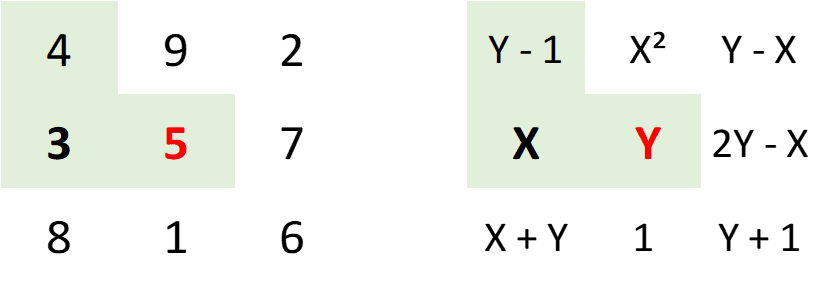
Table 1.  The first magic square and the corresponding formula; in the example of an order 3 magic square, X = 3 and Y = 5.  A magic square is defined as an arrangement of numbers in a square such that the sum of any row, column, or major diagonal will yield a singular result, in this case 15.  Pythagorean triads highlighted in green.  (Note: it is necessary to use Y as a means to express the fraction
(X2 + 1) ÷ 2 for an easier visual processing of the formula).

The formula above allows the generation of higher order magic squares in the Luo Shu format as long as
X is odd and greater than one. 

To understand the wisdom that the Luo Shu offers, one must consider that the Luo Shu represents a “set of magic squares” based on a common formula that can be expanded to include higher order magic squares; the Luo Shu is not limited to just the 3x3 magic square.  A “set” of magic squares traditionally used in alchemy would include the odd and even magic squares up to order nine; this author considers the Luo Shu set of magic squares to include only odd magic squares up to the order twenty-seven.  Examination of the math of the higher order magic squares will give insight to the various mathematical properties associated with magic squares in the Luo Shu format.

The fraction (X2 + 1) ÷ 2 will be represented by Y and will always equal the center number of the corresponding magic square.  X and Y will always be the odd components of a Pythagorean triad, (X)(Y) will equal the magic constant, and X2Y will equal the sum total of all the numbers in the square, or ∑X2.

Table 2.  The first three magic squares of the Luo Shu demonstrating the Pythagorean Theorem in the form of Pythagorean triplets of numbers (in green) in the shape of a gnomon or right angle.

The first significant feature of the Luo Shu is the Pythagorean triad of numbers in the shape of the carpenter’s square or gnomon, an important symbol that is closely associated with the Luo Shu as it also represents time and space as well as applied mathematics (see table 2).

The second outstanding feature of magic squares in the Luo Shu format is the cross of odd numbers that run through the horizontal and vertical axis with a center point of reference.

Table 3.  Example of the cross of odd numbers that will appear in every magic square in the Luo Shu format. Here, the 9x9 magic square. 9, 40, and 41 satisfy the Pythagorean or Right-Angle Triangle Theorem. (X)(Y) = 9 x 41 = 369, the magic constant.  In alchemy, this square corresponds to the moon.

The third important feature of the 3x3 magic square are the quincuncial relationships of even and odd numbers around the center number.  A quincunx is defined as an arrangement of five things with one at each corner and one at the center of a square. The even numbers of the first nine numbers will occupy the corners (or four quadrants) and the odd numbers will form a cruciform with the number five at the center; this is known as a double quincunx.

Table 4.  All magic squares in the Luo Shu format will have a cross of odd numbers that run through the vertical and horizontal axis.  The ya cartouche – cosmic temple – reflects this important feature of the Luo Shu.  The odd numbers equate to the heavenly yang force, the four cardinal directions and the center; the even numbers represent the earthly yin force.

The early Chinese believed these squares were a communication from Heaven because of the wisdom contained within.  As these squares exhibit the Pythagorean Theorem, a center, and a cross of odd numbers that separates the square into four quadrants, the “luo shu” squares became a perfect model to represent Heaven and earth in microcosm, to be used in art and architecture while at the same time communicate a wisdom of mathematics that would remain hidden, known only to the intelligentsia.  This explanation can help to understand why this pattern shows up across a diversity of cultures, beginning with the early Chinese and continuing thru the Renaissance era.  This model, or symbol, of numerology would therefore be transformed into an artistic composition of motifs beautifying tiles, pavements, mosaics, books, and textiles to mark structures and objects of religious or political import. 

Order your booklet today, The Secret of the Magic Square, Numerology in Art and Architecture PDF today, only $3

copyright registration number TXu 2-483-178
effective date of registration: January 30, 2025
Registration decision date: April 25, 2025
Author: Robert Dickter
United States Copyright Office

Wednesday, December 18, 2024

PORTABLE SUNDIAL, TYPE B

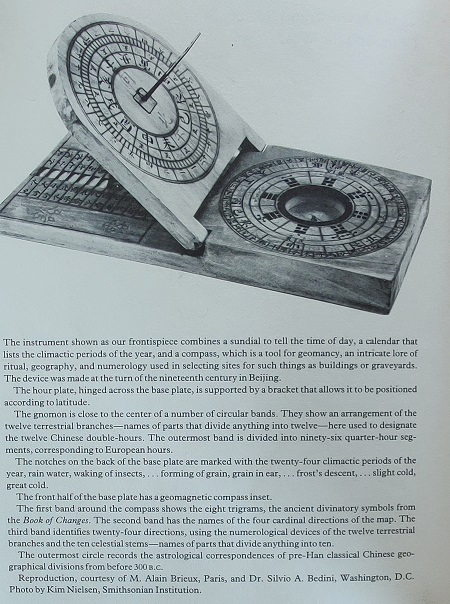
That the Luo Shu appears on Chinese sundials from the seventeenth century has never been documented until now.

This type of sundial did not appear much before 1600 AD.  Many replications of this instrument can be found at several museums.  The Type B sundial, or equatorial dial, became popular in Europe during the seventeenth century.  


One can clearly see the numbers of the Luo Shu in the second ring adjacent to the ring with the eight trigrams.  Even numbers are in black, odd numbers are in red.  It is perfectly appropriate for the Luo Shu to be used as a motif to mark astronomical instruments that are related to time measurement and space directionality.  

Instruments such as the portable sundial help humankind to connect with Heaven.  The Luo Shu has a legacy of being related to the calendar, the Pythagorean Theorem, the carpenter's square and the gnomon.  

From Science and Civilisation in China, p. i of every volume:

The carpenter's square is no ordinary tool, but the gnomon for measuring the lengths of the sun's solstitial shadows. 

The above pictures were taken from Time, Science, and Society in China and the West edited by J.T. Fraser, et al (1986).  Another example can be found in Science and Civilisation in China, Vol. 3, p. 308, Figure 134.  Please note the editor offers explanations of the markings in each of the rings around the compass but makes no mention of the Luo Shu being present in the second ring.  This is the first time this observation has been noted.

Symbols such as the Luo Shu and carpenter's square are frequently used in art and architecture to identify things of political or religious significance such as temples, churches, art, architecture, and astronomical instruments.  

My paper, The Secret of the Luo Shu, Numerology in Art and Architecture explains in detail the use of the Luo Shu and related symbols as an artistic motif used by many cultures for over two thousand years.  

Order you PDF today! (Sale, PDF is $3 until Dec. 31, 2024).

Sunday, December 8, 2024

9X9 MAGIC SQUARE

The feature that makes this magic square most unusual is another magic square appears within its framework.  That demands further inspection.

I found this square on Jollymaths.com

Reducing the numbers of this 9x9 magic square to their Pythagorean root number generates a square of repetitive Luo Shu magic squares.  The entire square becomes nine individual 3x3 magic squares.


Notice there are nine consecutive numbers in each grouping with the first nine numbers located in the first row middle column grouping.  


The second grouping of consecutive nine numbers, ten thru 18 can be found in the lower right grouping of numbers.  The third set of consecutive nine numbers, nineteen thru twenty-seven, can be discovered in the first column middle row group.  If each group of nine numbers is assigned its position in a 3x3 grid according to numerical order, then the Luo Shu magic square shows up once again.

Wednesday, December 4, 2024

THE 21X21 MAGIC SQUARE and HE TU

If all the numbers in the 21x21 magic square are reduced to their Pythagorean root number, the He Tu pairing emerges.  In addition, the 3x3 magic square appears along the major diagonal that runs from the upper right to the lower left corner cells.  The He Tu pairing can be found in the 3x3, the 9x9, the 15x15, the 21x21 and the 27x27 magic squares.


The magic constant of this square is (21)(221) = 4,641; every row, column, and major diagonal sum to this number.  Note the cross of odd numbers that run through the horizontal and vertical axis of the square.


Every number one is paired with every number six and so on for two-six, three-seven and four-nine.  The pattern that emerges is different for each square the pairing occurs in.


This post demonstrates that the He Tu pairing is to be found in the Luo Shu magic squares.

Note:  There are some unpaired numbers along the borders of the magic square.  Keeping in mind the magic square is the two dimensional image of a torus, the numbers that are unpaired actually have their paired mate located at the opposite border in the same row or column so in three dimensions the pairing is complete.  Five is unpaired as it represents the central pivot.  

As stated above, the pairing can be found in several squares, beginning with the 3x3 M.S. and skipping every six orders so the next magic square that the He Tu will be discovered is the 9x9 M.S.

This proves that the He Tu pairing originates from the Luo Shu format of magic squares.  This assertion has been made previously by Lars Berglund in his book, The Secret of the Luo Shu, Numerology in Chinese Art and Architecture (1990).  Berglund puts forward his theory but offers no evidence, now we have the evidence.

Thursday, November 28, 2024

The Magic Square and La Sagrada Familia

FROM THE PAPER  "THE SECRET OF THE MAGIC SQUARE, NUMEROLOGY IN ART AND ARCHITECTURE

copyright registration number TXu 2-483-178
effective date of registration: January 30, 2025
Registration decision date: April 25, 2025
Author: Robert Dickter
United States Copyright Office

La Sagrada Familia, Barcelona, Spain

The magnificent church, La Sagrada Familia, was started in 1892 by architect Antoni Gaudi and is presently still under construction although a completion date of 2026 has recently been announced.  Two significant features relevant to this paper are the appearance of a magic square albeit an even magic square of order 4, and the coded use of numbers reflecting the Pythagorean Theorem. 


Image 19.  A 4x4 magic square on the Passion Facade of La Sagrada Familia with a magic constant of 33.

This is not the traditional magic square of order 4 as that square would have 34 as the magic constant.  This square uses two 10s and two 14s in order to have the magic constant equal 33, a reference to the age of Christ when he died.  A traditional 4x4 magic square would have the numbers one thru sixteen and there are 880 different arrangements of numbers to achieve this end.                        


Stained glass image of quincuncial composition in La Sagrada Familia using the classic quincunx and comparing to jewelry from the Lazaro Galdiano Museum, Madrid.


Stained glass window exhibiting the Pythagorean Theorem in code, La Sagrada Familia.

Counting the number of petals in the large circle, one comes up with 16 or 42.

Counting the number of circles including the large circle (but not the real small circles) one comes up with 25 or 52.

Counting the tomb shaped figures on one half of the window, one comes up with 9 or 32.

32 + 42 = 52

Could it be a coincidence that Gaudi uses a magic square, makes a coded reference to the Pythagorean Theorem, and uses quincuncial composition?  The magic square represents the establishment of order on earth by connecting with Heaven thru the use of mathematics; repetitive concepts familiar to early Christian art and architecture. 

La Sagrada Familia, outside of church.
Another example of Gaudi's use of square numbers:  there are 81 (92) circular windows in the above picture, the last grouping has 9 windows and both 81 and 9 are powers of three (the triad). 

for PDF of the complete paper (36 pages), 
email:  robert.luoshu@gmail.com
$7.00

25 images and 15 tables, discusses in detail the magic square and its relevance in early China and the West as a motif in art and architecture.

©2025 pending


Wednesday, September 18, 2019

MUSIC AND THE MAGIC SQUARE

I have always wondered why this 3x3 pattern appears on bronze bells from over 2,000 years ago.  These bells were known to be used for ceremonial purposes and were played in the royal court. Examining the relationship of the Luo Shu, He Tu, and number manipulation may lead to some interesting results pertaining to music.
Upon close examination of the 9x9 magic square in the Luo Shu format, it can be demonstrated that the He Tu pattern presents itself. 


First, a review of the 3x3 magic square also known as the Luo Shu. It is important to realize that the 3x3 magic square has a formula:


3x3 Magic Square FORMULA
4 9 1 Y + 1
X2
Y - X
3 5 7 X Y 2Y - X
8 1 6 Y + X 1 Y - 1

A) Formula for 3x3 magic square which can be expanded to larger magic squares.1

This relationship can be expanded into larger order magic squares that all feature a Pythagorean triplet of numbers at the heart of every magic square. In addition, the numbers of the calendar are featured in the 13x13 and 27x27 magic squares. For these reasons, the Luo Shu was considered an ideal model of time and space. 
[For convenience, Y = (X2 + 1) ÷ 2].

(Note: The Chinese translation of Luo Shu and the He Tu deserves a moment of reflection. He Tu translates as Yellow River Chart indicating a singular image. Luo Shu translates to Luo River Document or Luo River Writing possibly indicating multiple images. It is best to think of the Luo Shu as a set of magic squares based on a formula that describes the simplest magic square, the 3x3, but can be expanded to include larger order magic squares that have relevance to the Chinese numerology system. 

The Luo Shu is from Heaven


In a perfect world, the music of the royal court would be composed by Heaven and not by humankind. Music was considered to be a gift from Heaven, as are numbers and the math that follows.

The early Chinese placed a sacred bestowment on all instruments that connected civilization with Heaven. Astronomical instruments, musical instruments, and mathematical tools such as the carpenters’ square and numbers were entities that allowed humankind to connect with Heaven. Some of these astronomical instruments (the bi disc and cong tube) became relics used in ceremonies, other tools such as the carpenters’ square became iconic symbols.  These religious relics and iconic symbols could find their way into the royal tomb to assist in the emperor’s journey thru the underworld.

The early Chinese believed that to evolve and prosper, the sacred rules of Heaven must be followed. Within the math of numbers (i.e. the language of Heaven) was a plan; society could apply mathematics and succeed. This so called “plan from Heaven” comes from the Hong Fan, a legendary Chinese belief system that claims the Luo Shu Magic Square contains the “plan for humankind”.  Regardless of Chinese mythology, it is clear that the “set” of magic squares in the Luo Shu format are not man-made, these mathematical relationships must be discovered by man and therefore are constructed by “nature”.


Hence, magic squares were part of an armamentarium of important tools (or instruments) that helped guide the early Chinese as magic squares (in the Luo Shu format) were a major influence on:  temple design, pictograms of the Chinese language, art, and even tomb and city design.2  This is consistent with early Chinese classification systems that depend on centrality, order, and symmetry.  As the magic square was the perfect model for these requirements, the early Chinese, especially the royal court, invested heavily (labor, materials, money) by incorporating the esoteric, yet mathematical, philosophy of the Luo Shu into society over a period of 2,000 years (1,100BC to 1,000AD). Although the Luo Shu was not included in the Yi Jing until about 1,000AD, there can be no doubt that the legacy of the Luo Shu had begun over 2,000 years prior to this inclusion!

THE 9X9 MAGIC SQUARE AND THE HE TU

 9x9 Magic Square 9x9 reduced to Pythagorean root number
37 78 29 70 21 62 13 54  5 1 6 2 7 3 8 4 9 5
 6 38 79 30 71 22 63 14 46 6 2 7 3 8 4 9 5 1
47  7 39 80 31 72 23 55 15 2 7 3 8 4 9 5 1 6
16 48  8 40 81 32 64 24 56 7 3 8 4 9 5 1 6 2
57 17 49   9 41 73 33 65 25 3 8 4 9 5 1 6 2 7
26 58 18 50  1 42 74 34 66 8 4 9 5 1 6 2 7 3
67 27 59 10 51  2 43 75 35 4 9 5 1 6 2 7 3 8
36 68 19 60 11 52  3 44 76 9 5 1 6 2 7 3 8 4
77 28 69 20 61 12 53  4 45 5 1 6 2 7 3 8 4 9
B) Here one one can see the He Tu pattern emerge when the numbers are reduced to their Pythagorean root number.

In order to apply musical notes to this arrangement of numbers it is useful to know that in the ancient Chinese musical gamut, 5 notes made up the pentatonic scale. The Pythagorean root numbers will be re-written in Base 5 notation to match the pentatonic scale:

Translating to Base 5 notation
1
11
2
12
3
13
4
14
5
11
2
12
3
13
4
14
5
1
2
12
3
13
4
14
5
1
11
12
3
13
4
14
5
1
11
2
3
13
4
14
5
1
11
2
12
13
4
14
5
1
11
2
12
3
4
14
5
1
11
2
12
3
13
14
5
1
11
2
12
3
13
4
5
1
11
2
12
3
13
4
14


C) The Pythagorean root numbers translated to Base 5 notation


Note C is selected as the middle note of the pentatonic scale, note C is assigned to the number five, and with that the rest of the notes (A, B, E, and G) fall into place. The six is translated to eleven in base five notation and refers to the A note of the second ascending scale and is noted as A(2).

NUMBERS IN
NUMBERS IN
NOTE
BASE 10 NOTATION
BASE 5 NOTATION
1, 6
1, 11
A, A(2)
2, 7
2, 12
B, B(2)
3, 8
3, 13
E, E(2)
4, 9
4, 14
G, G(2)
5
5
C

D) The numbers have been translated into Base 5 notation and assigned musical notes in the Pentatonic scale.

E) The He Tu combined with the Luo Shu and the musical notes assigned to the numbers.


Sequence of notes
FIRST STANZA
5, 1, 6  =  C, A, A(2)
5, 7, 2  =  C, B(2), B
5, 3, 8  =  C, E, E(2)
5, 9, 4  =  C, G(2), G

F) Sequence of notes determined by numbers of the He Tu combined with the Luo Shu


The wan character, 卍,has been associated with the He Tu and the Luo Shu.  Berglund  maintains that the symbol 卍 was based on pairs of numbers of the Luo Shu Magic Square representing the five elements and, by extension, the universe.3  (Aihe Wang, A.C. Graham, and Sarah Allan all support the Si Fang/Wuxing philosophy involving the Luo Shu and He Tu).4  If this is true, then the 卍 comes from the He Tu numerical pairs being emphasized on the Luo Shu 3x3 grid of numbers, creating the pairs of numbers associated with the middle number, 5. This gives the symbol  卍 mathematical relevance and corresponds to several important Chinese philosophical concepts: the four cardinal directions, Heaven and earth, the five elements, the axis mundi or cosmic center, the carpenters’ square, the right angle triangle theorem, the gnomon and time keeping.  As this pattern (1,6; 2,7; 3,8; 4,9; 5) appears in the 9x9 M.S., then there can be no doubt that the He Tu pattern is related to, and even comes from, the 9x9 M.S. (see table B above).  The Luo Shu and He Tu were the two main mathematical philosophies by which everything in the YinYang/Wuxing compendium was connected.


Therefore, are the He Tu and Luo Shu the basis of early Chinese ceremonial music? If a musical composition were to be based on the mathematical patterns of the Luo Shu and He Tu, then this music could be hypothesized to be “from Heaven” and be consistent with YinYang/Wuxing philosophies. In other words, music derived from the mathematics of the Luo Shu would be ideal for sacred and ceremonial music as well as music for political purposes.


Footnotes and References
1.       1. Dickter, Robert, Number Time Archetype, California (2014)
2.       2. Schinz, Alfred, The Magic Square, Great Britain (1996)
3.       3. Berglund, Lars, The Secret of the Luo Shu, Sweden (1990)   
          4. Wang, A.E., Cosmology and Political Culture in Early China, Cambridge (2000)